If you've ever tried to budget by hand, you know the real chore isn't the math — it's the sorting. Was that charge groceries or household? Is the coffee shop "dining" or "coffee"? Which of the 30 transactions this week were subscriptions? Manually tagging every purchase is tedious, and tedium is exactly what kills budgets.
AI expense categorization exists to remove that chore entirely. But "the AI figures it out" can sound like a black box, so let's open it up and look at how it actually works — and why it makes budgeting realistic for people who'd otherwise give up.
The problem it solves
A bank transaction is surprisingly unhelpful on its own. It usually shows up as something like a cryptic merchant code, an amount, and a date. "SQ *MAPLE CAFE 604" doesn't tell a spreadsheet anything useful. A human can guess it's a coffee shop; a simple rules-based system often can't.
Older budgeting tools tried to handle this with fixed rules: "if the merchant contains 'UBER', tag it transport." But rules are brittle. They miss new merchants, get confused by ambiguous names, and can't adapt to the fact that the same store might mean groceries for one person and a quick lunch for another. AI takes a smarter approach.
How the AI actually decides
Modern expense categorization works by reading the context of a transaction, much like a person would, and matching it to the most likely category. A few signals do the heavy lifting:
- The merchant name. The model has learned, from enormous numbers of examples, what kinds of businesses sit behind millions of merchant names — even messy, abbreviated ones.
- The amount. A $4 charge and a $400 charge at the same type of place often mean different things. Amount adds important context.
- Patterns over time. A charge that repeats on the same day each month looks like a subscription or bill. The AI can recognize that rhythm.
- Your past behaviour. This is the key one — more on it below.
Instead of a rigid "if this, then that," the model weighs all these signals together and assigns the category that best fits. When a merchant it's never seen appears, it can still make an intelligent guess based on everything that merchant resembles.
Why it gets smarter the more you use it
The single biggest advantage of AI over fixed rules is that it learns from you. Everyone's spending is a little different — what's a "want" for one person is a recurring necessity for another. So when you correct a category — moving a charge from "dining" to "business," say — the system remembers. The next similar transaction gets categorized your way, automatically.
Over a few weeks, this feedback loop tunes the categorization to your specific life. The corrections you make early on pay off as fewer and fewer corrections later. The tool effectively learns your habits and starts thinking the way you do about your own money.
Why accurate categorization actually matters
This isn't just a convenience feature. The entire usefulness of a budget depends on the categories being right. If half your restaurant spending is mislabelled as groceries, your "food budget" is fiction and your decisions are based on bad data. Good categorization is what makes every downstream insight — your monthly totals, your category alerts, your spending trends — trustworthy.
Get the sorting right automatically, and budgeting transforms from a nightly data-entry task into something that simply happens in the background while you live your life.
How TrackE5 handles it
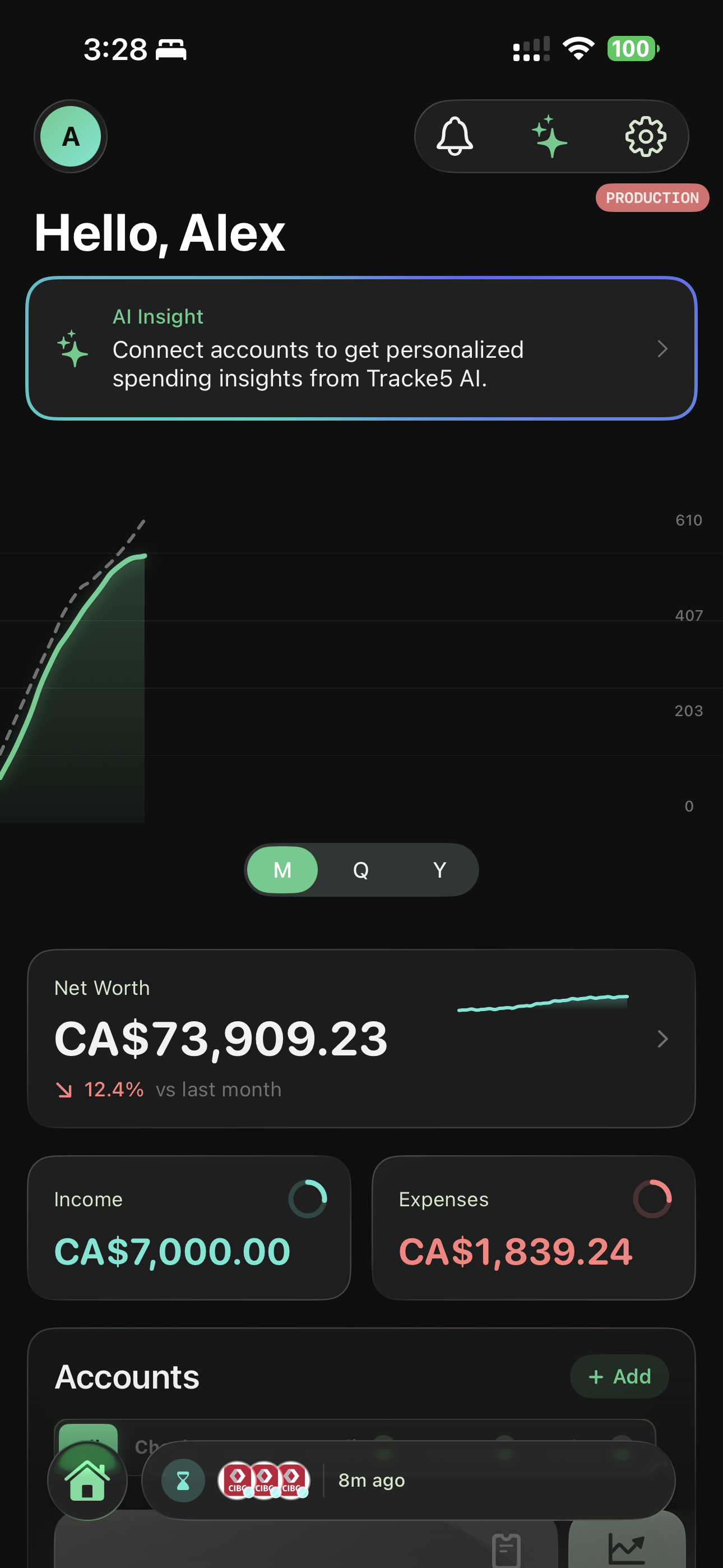
TrackE5 connects to your Canadian or American bank through Plaid and imports your transactions automatically. As each one comes in, the AI reads the merchant, amount, and context, and assigns a category — across CAD and USD natively. When it gets one wrong, you correct it once, and it learns. Prefer to add things manually or snap a receipt photo instead? That works too, and the AI sorts those the same way.
Crucially, all of this happens inside an end-to-end encrypted, zero-knowledge system. The categorization works on your behalf, but your underlying financial data stays private — even from us.
The bottom line
AI categorization isn't magic, and it isn't a gimmick. It's a practical solution to the one thing that makes budgeting fail for most people: the effort of sorting. By reading context, learning from your corrections, and handling the tedium automatically, it turns a clear picture of your finances from a weekend project into something you barely have to think about. And a budget you don't have to think about is a budget you'll actually keep.